


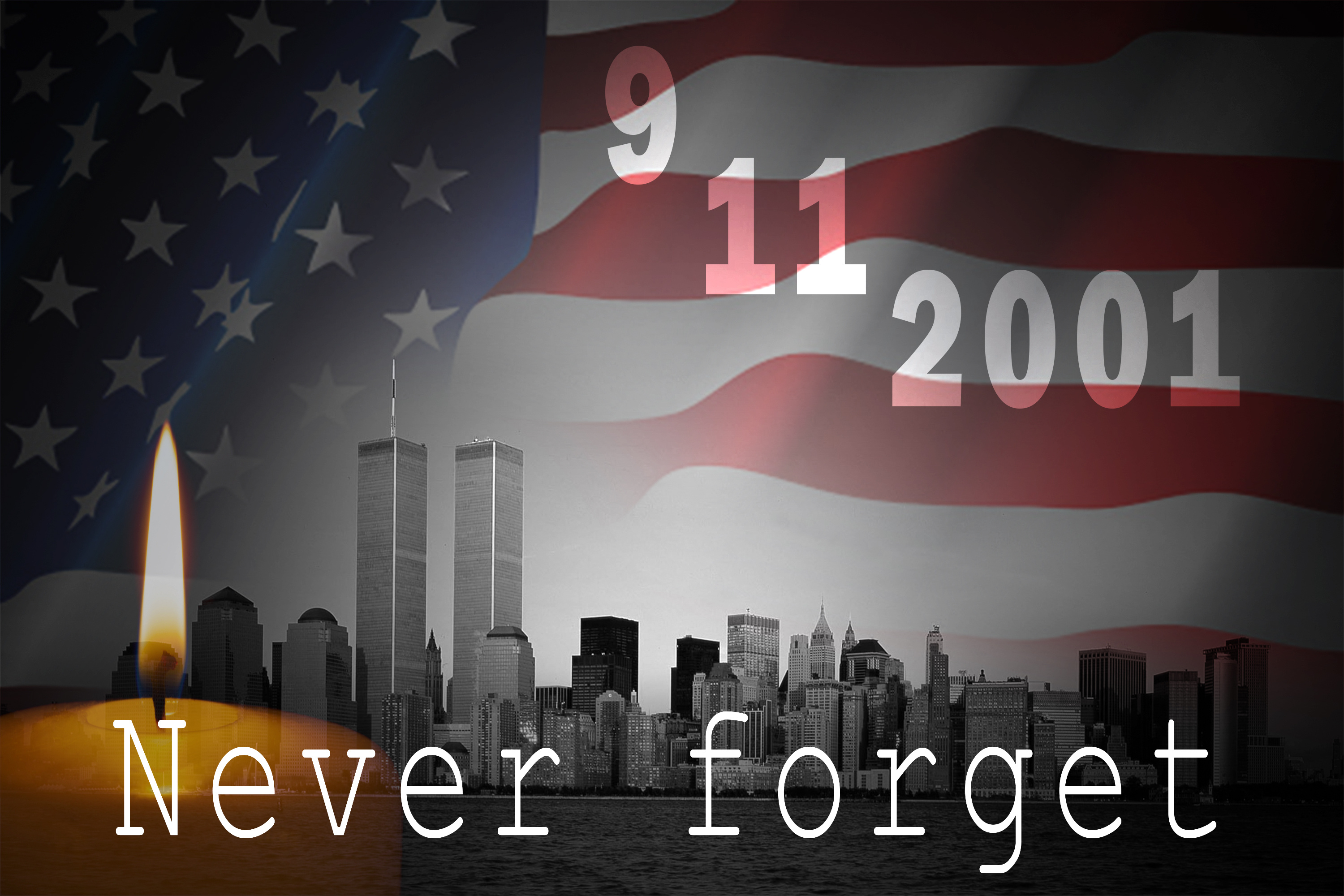
Earlier today, I looked through my old posts from September months, searching for my 9/11 story. I thought it might be a good time to republish it, simply because my students that I teach now in 2023 weren’t even born when planes crashed into our buildings.
I think it’s a lot like Pearl Harbor or the Kennedy Assassination to me and those in my generation. We weren’t born when those things happened, and there was no relevance, no connection except that our parents were alive then (maybe not for Pearl Harbor, but most for the Kennedy Assassination). My parents never really talked about either – you know, the “where were you when” conversations that seem so big these past 22 years regarding September 11. I know these are “never forget” moments for those who experienced them, but I don’t remember hearing the stories.
And my students seem interested – they really do – but from a distance. Years ago, when I would talk about 9/11 with my students in the earlier anniversaries, mostly 2005-2012, they had stories to share, too. It was a communal experience, a complicated, damn-the-generation-gap moment where we were all like, Yeah, we were there together. I get it. I get you. We will never forget.
Not so much anymore. My students are where I was regarding the Kennedy killing – 20+ years had passed, and I watched the Zapruder film and said, “wow” a lot. Then moved on. I think we all did.
I don’t want that to be the case for our children growing up 22 years after our Kennedy moment. I want them to know what happened from a personal perspective, and why it still matters to me, and why I want it to matter for them.
When Tim O’Brien wrote The Things They Carried 20 years after he left Vietnam, he accepted the challenge to tell his story in a way that even those who were not of that era could still understand, could still feel what that war was like. He punched through the “so what’s” that we often have when we can’t immediately connect or say that we were there.
We need to keep doing that. We need to keep sharing our stories of that tragic day so that they can be understood by the world, regardless of when the world might read them.
This is one of the reasons why I, and a few other writers, put together the 9/11 project for the citizens of the State of Maryland just days after the tragedy. We collected hundreds of stories from Marylanders ages 8 to 88, politicians, artists, military personnel, mothers, children. We published the anthology September Eleven: Maryland Voices on September 5, 2002, and copies of that publication remain with the state archives (and at Enoch Pratt Free Library) as Maryland’s definitive reaction to that day.
I pored through every September entry ever written and published about 9/11, and I could not find one post that shared my story. Ridiculous. So that is why I am here now. To share my story so that it, too, is offered up to the masses from today and beyond so that everyone who reads it will know, at least, this one person’s story of what happened.
Here we go.
You’ve heard how blue the sky was from just about everybody who has described that morning. Azure, brilliant, deep blue. It’s true. Every adjective does not give justice to the perfection of that morning. I was living in Towson, just off of York Road by the bypass and down the street from the Fire Station No. 1. My wife Amy and I already had one child – Holland – who was 5. Amy was in her eighth month carrying our second child, Madelyn, who was scheduled to be born the end of October. I was teaching at Towson University, working at Success For All (SFA) Foundation in Towson, and just beginning my MFA in Creative Nonfiction program at Goucher College. The weather was so nice that morning, I decided to walk the 1.5 miles to SFA and enjoy the early autumn bustle of downtown Towson.
I left the house around 8am. As I approached our building on Towsontown Boulevard, I glanced at the National Guard Armory building on the other side of the street. My only interaction with that beautiful stone structure was the Smith College book fair that was held there every year. What a bargain! On the last day, you could take all the books you could carry for just a few bucks. Not a bad deal. Some of the books I found there are still in my library today.
The building was still, as always. Nobody coming in or out, no open doors. I often wondered if its only purpose was to host that annual book fair.
I walked into the entrance of the SFA building, climbed the steps to the third floor (or so I believe), and entered my small office, eager to make some progress on the Hercules unit I was writing for middle schoolers.
Less than an hour later, a little after 9am, Sally, one of my co-workers, peeked her head into my office. She had a solemn look on her face.
“Rus, we’re all gathering in the conference room. Something’s happened. You might want to join us.”
I got up and followed Sally down the hall, fearing the worst. A colleague was ill. SFA was folding. I really didn’t know, but Sally’s voice and expression told me it wasn’t good.
When I turned in to the conference room, all of my colleagues were facing a single television in the far left corner. The live shot was of the two towers, billowing smoke finding its way upward into that brilliant blue sky that we still can’t stop talking about.
“What is happening?” I whispered.
“Two planes have crashed into the World Trade Center,” Sally said. “Isn’t it awful?”
I nodded, unable to stop watching the live coverage like everyone else in the room. We were paralyzed with wonder: What exactly is happening?
Then, shortly after 9:37am, a small frame within the larger live shot of the towers appeared in the bottom right corner of the television. Bryant Gumbel, who was narrating this unfolding tragedy for the CBS network news, stopped talking. We all stared at the images now before us: two towers in New York City hit by planes, and now there had been an explosion at the Pentagon building less than 50 miles from where we were.
That was all I needed to see. I got up, told my boss she could fire me if she wanted, but I was heading home to be with my wife and unborn child. Nobody knew if this was the end. If we were at war. If the world was changed forever.
She nodded and said, “Go.” Many of us did.
When I stepped outside, I looked across the street.
Indeed, the world had changed.
The Towson Armory for the National Guard, which was dormant just hours ago, was now bustling with war-like activity. Soldiers in full combat gear and rifles were securing sandbags around all entrances. When I walked into SFA, the world was a peaceful place, at least in my corner of the world. When I exited, we were at war with an enemy we did not know, and we did not know if the worst was yet to come.
I rushed home to be with Amy and our unborn child. I burst into tears the moment I saw her. She had the television on, and together we watched the north tower collapse (the south tower had collapsed on my way home).
While Amy was trying to reach her mother, who was at work in Liberty Plaza right next to the Towers, I looked outside and noticed there was no air traffic; everything was being shut down. I did not know that Flight 93, heading toward either the White House or the US Capitol, had crashed just 3 minutes after the south tower had collapsed. I wondered if it would crash near us, or if it would be shot down by military planes dispatched to intercept it.
We just didn’t know.
And then the world stood still while we all held our collective breaths for what might come next.
Our first-born daughter, Holland, was five years old and at her Montessori school in Perry Hall. That afternoon, we were able to pick her up. When she got into the car, she said two things:
“Okay. Why is Mix 106.5 not on the radio, and why is Daddy picking me up?”
There was no music on the radio. Mix 106.5 and every other radio station carried the live emergency broadcasts of the terrorist attacks. There was no music playing on September 11, 2001. It was the second day that the music died in America.
That night, as we still could not reach Amy’s mother and feared the worst, we sought normalcy in our world. We decided a trip to Target would be good. The ride there was eerie. No cars were on the road, no sounds were in the air. It was like we were in the middle of some kind of post-apocalyptic event. Maybe we were, but we needed something routine to assure us – in some crazy way – that all of this was going to be okay.
When we entered the store, it was just as eerie as the world we left on the other side of the sliding doors. It seemed like wherever we went, everything was different. I guess now we might call it the Upside Down. That’s exactly what it was like. This was my town. These were my stores. But nothing was right. Nothing looked, or sounded, or felt right. Everything was wrong.
No music played inside the Target store. We were only two of a few who were shopping in the store, and all we heard were the echoes of store-use walkies that chatted about aisles and palettes and every other thing that seemed irrelevant to us.
We stayed up nearly all night listening to the news. Calling loved ones when we could get through. Checking in on each other. Saying I Love You and meaning it like we might not get the chance to ever say it again. That’s just what it was like.
What did we say last to Amy’s mom? Did we say we loved each other? How long ago had we talked to her? Was she still alive? What was she thinking? Was she trying to reach out to us? Or had she died? And if so, what were her final thoughts? Did she know we loved her? That we were so worried about her? That we tried to reach out to her? Endlessly? Helplessly?
It wasn’t until close to midnight that we finally heard from Amy’s mom. What a relief to hear her voice and know that she was not one of the thousands of missing among the rubble in New York City. Her tale was harrowing, and it haunted her until the day she died six years later.
The next day, I left the house to get some food about lunch time, and I threw a CD into the player for a much-needed break from the news. As I headed into the center of Towson, where a large oval roundabout joined five streets meeting from all directions, Toad the Wet Sprocket started playing the song, “I Will Not Take These Things For Granted.” I started to lose it all over again when I noticed the flags atop the Barnes & Noble building flying half-staff. The tears would not stop as I tried my best to sing the lyrics:
I will not take these things for granted (flowers in the garden)
“I will not take these things for granted” -Toad The Wet Sprocket
I will not take these things for granted (laughter in the hall)
I will not take these things for granted (a child in the park)
I will not take these things for granted (dive into the ocean)
I will not take these things for granted (singing by the fire)
I will not take these things for granted (the rolling canyons)
I realized then that our second child, Madelyn, would be born into a very different world. She would never know what life was like before September 11. It devastated me that the freedom we once knew, the innocence we once had, would not be in the world in which she was born.
Madelyn has grown up to be a strong, independent woman, experiencing and expressing her world as an artist. The fears that I had in the weeks leading up to her birth, and immediately afterward, were allayed by the simple fact that she knew no other world. Her journey was her own, and she embraced it fully.
As for Amy and me, we will never forget that day. The terror, the unknown, and the understanding that everyone’s world had changed forever. To my students, friends, and family who experienced this with us, You are not alone, nor will we ever forget the lives of those we have lost along the way.
It’s an odd thing. We strive for normalcy in a world that is anything but normal; we pray for peace in a world that is filled with hatred and divisiveness. And yet, we carry on. We face each new day with renewed hope for a better tomorrow. We hold on to the belief that we can make a difference with our actions, our prayers, our love.
September 11, 2001. We will never forget. And I hope you don’t, either.

 Rus VanWestervelt
Leave a comment